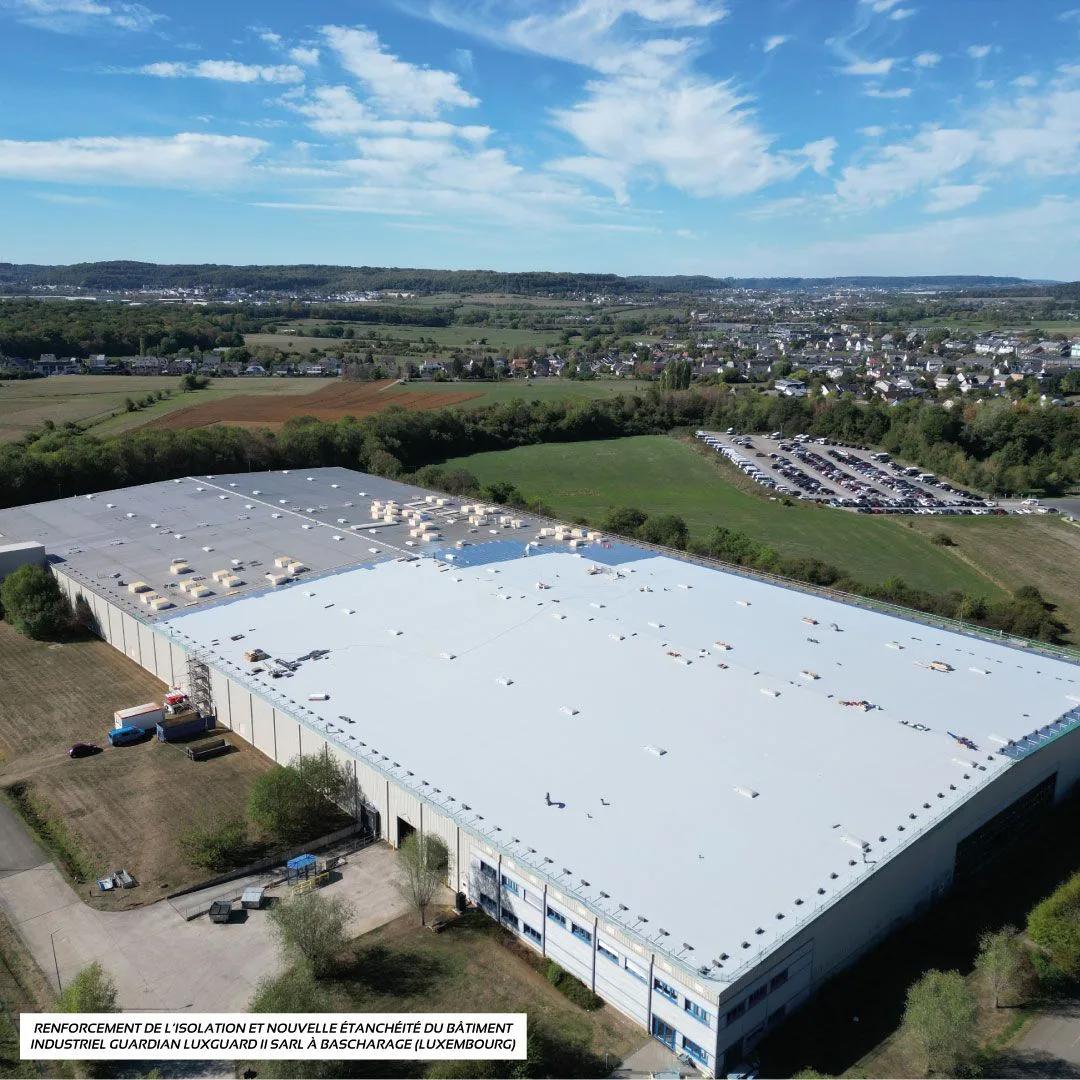
An industrial roof may still be protecting the building properly while its thermal insulation has become inadequate. In that case, is it really necessary to replace the entire roof to improve the building’s energy performance?
How insulation reinforcement works
Where the condition of the existing roof system allows, the insulation can be reinforced while keeping the elements that are still usable. This involves adding a new layer of insulation combined with a suitable waterproofing membrane, without necessarily stripping the whole roof.
This solution improves the building’s thermal efficiency and limits energy losses linked to heating or cooling. It also has the advantage of reducing stripping work and the waste generated by the renovation.
A solution to be validated by prior analysis
The benefit of reinforcement depends in particular on the roof area, the condition of the existing insulation and the temperature maintained inside the building. Over several thousand square metres, improved insulation can be a major lever for controlling energy consumption.
Feasibility does, however, depend on the condition of the existing insulation, the condition of the substrate and the capacity of the building’s structure. A prior analysis remains essential to determine whether reinforcement is suitable or whether full replacement should be considered.
“Improving a roof’s energy performance does not necessarily mean starting from scratch.”
The benefits of reinforcing the insulation
- Energy performance: reduce heat loss and improve the building’s thermal efficiency.
- Keeping what works: retain the elements that are still usable without replacing the entire roof.
- Optimised works: limit stripping, waste and on-site constraints.
- Lasting protection: combine reinforced insulation with new, durable waterproofing.
Is the insulation of your industrial building ageing? Have your roof analysed to identify opportunities for reinforcement and energy improvement.