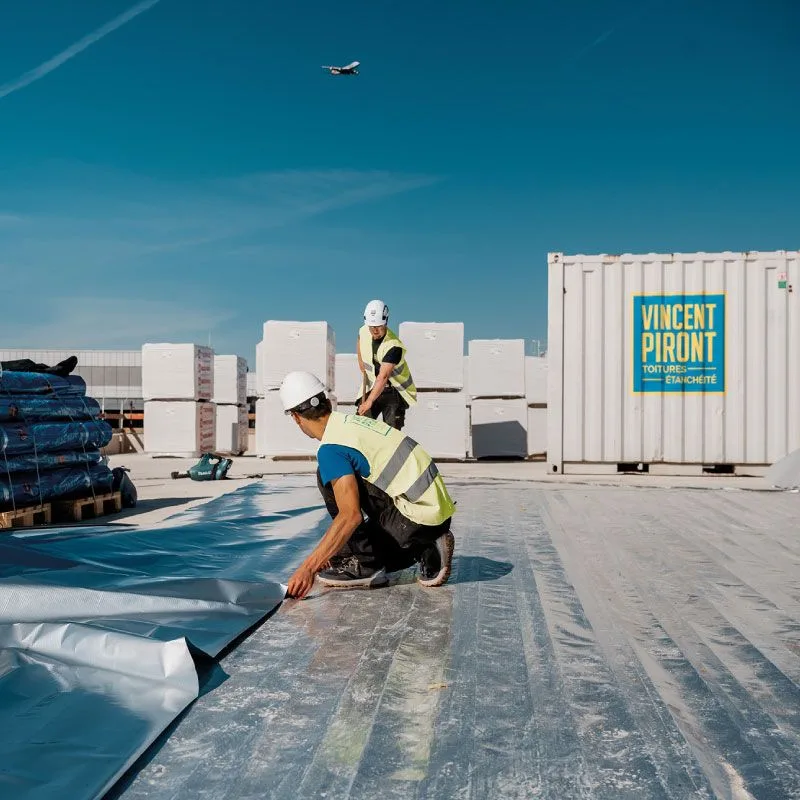
During a roof renovation, the humidity inside the building can directly affect how the roof system behaves. Depending on the activity, the indoor temperature and the humidity level, water vapour can migrate towards the roof and, in certain configurations, lead to condensation.
Humidity testing, a preliminary step
That is why a humidity test can be carried out before the work begins. It measures the actual conditions inside the building, determines the performance of the existing roof system and, where necessary, allows it to be adapted as part of the renovation.
This analysis is particularly important in production units, where the activity can create specific indoor conditions in terms of temperature and humidity.
The vapour barrier: much more than an extra layer
The vapour barrier should therefore not be seen as just an additional layer. The type of vapour barrier is chosen on the basis of the results of the preliminary analyses. This choice prevents any risk of condensation inside the roof system or inside the building. Vincent Piront SA adapts the solution to the building’s activity and indoor conditions.
“In an industrial building, indoor humidity must be taken into account to design a suitable, durable roof.”
Key points for a roof suited to indoor humidity
- Indoor humidity: water vapour produced in the building can migrate towards the roof and cause condensation.
- Indoor conditions: temperature and humidity level must be taken into account when designing the roof system.
- Building activity: each production unit generates its own temperature and humidity level.
- Suitable vapour barrier: it prevents any risk of condensation and helps preserve insulation performance.
Does your production unit or building generate humidity? Have your roof analysed before starting work. Our teams will help you design a roof system suited to your activity.